Showing posts with label FML Book Club. Show all posts

Friday, September 16, 2011

Madam Secretary: a Memoir by Madeleine Albright

The first woman to hold the office of Secretary of State, Madeleine Albright, has written, with Bob Woodward, a comprehensive and detailed personal account of her life and public service in Madam Secretary. The memoir is accessible, very readable, and thought provoking. I knew very little about Madeleine Albright before reading this book except for the facts that she was a Czech, graduate of Wellesley College, and Secretary of State. The Flower Library Book Club chose this as their first book of the year and my new book club at The Gables requested that the members read a biography of choice. And so it was that I picked up Madam Secretary.

Born in Prague in 1937, Albright was the daughter of Josef and Anna Korbel. Her father was a diplomat and supporter of democratic Czechs who with his family was forced to leave his native land during World War II and live in England. After the war and the liberation, the family returned to Czechoslovakia and Madeleine was sent to a boarding school in Switzerland. In 1949 the family was granted political asylum and moved to Long Island. Eventually Josef Korbel
moved to Denver and began teaching at the University of Colorado. He was well-known for his treatises on Communism in Eastern Europe and actually had another Secretary of State, Condoleezza Rice, as a student. Albright graduated from Wellesley College in 1959 and immediately married Joe Albright, a well- connected journalist from Chicago. After a series of moves the couple settled in Washington where Joe became Newsday's Washington Bureau Chief and Madeleine continued to balance raising her family (3 daughters) and continuing her education - PH.D degree from Columbia University. She was married to Joe Albright for twenty-three years before he decided that it wasn't working for him.

Suffice it to say that no moss grew under Albright's feet. She is incredibly intelligent, driven, and committed to making the world a better place. Madam Secretary
relates Albright's journey from a legislative assistant to Ed Muskie to the end of President Clinton's second term. She not only details the behind the scenes machinations of international diplomacy, but she also brings a personal side to the strategies involved. During her tenure as Ambassador to the U.N. and then as Secretary of State, global conflicts erupted with a vengeance. At times I felt that Albright was playing the arcade game of "Whack a Mole" as she tried to handle situations from Somalia to Bosnia to Iran, to Korea. Although the book at sometimes got bogged down in names and policy making, it served to illuminate all that is involved in trying to get nations to talk to one another instead of acting like kindergartners fighting over a cookie. Her description of an Israeli-Palestinian summit at Camp David was indicative of all that she was willing to do to affect a lasting peace in the Middle East.

Perhaps her greatest efforts were in the area of Kosovo, Sarajevo, Bosnia, Yugoslavia, and Czechoslovakia. Her dealings with Milošević were tough and unrelenting. This was an area of the world that meant so much to her and she was determined to make it safe for all people regardless of their ethnic or religious background. She likens her diplomacy to Bobby Fischer playing chess as a child prodigy when he would go from table to table and make his moves against opponents. Albright remarks,
"I was no child prodigy and the faces I saw as I proceeded from one table to the next were those of Saddam Hussein, Muammar Quadhafi, Fidel Castro, and Ayatollah Khamenei. The games were complicated because a change in the momentum of one altered the dynamic of every other; our moves were decided by committee and leaked in advance by those who disagreed; new and contradictory strategies were being shouted out by a chorus from Capitol Hill, and the chessboard for the Middle East keep tipping over, requiring the contest to begin again. The game room was already crowded to overflowing early in 1998 when yet another familiar adversary—Slobodan Milosević—came crashing through the door." (p. 481.)
I was particularly interested in the personal side to all the strategies and inner workings of her office. She exuded confidence, but still had doubts as to how well suited she was for her job. She knew that she was a "skirt among 14 suits" but at the same time knew that her education had prepared her to be on an equal plane. She stressed over throwing the first ball out at a Nationals game, but did just fine. She was not afraid to accompany bodies back from Somalia, sleeping on a cot in the cargo bay. I am so impressed of all that she has accomplished and the means by which she influenced decisions and got HER point across. At the same time I empathize with her about her self-doubts, illustrated by the possibility of her marriage being salvaged if she had not pursued her career or if Joe had won the Pulitzer Prize. What kind of an ultimatum is that?

With a complete chronology of the major events in her life, an exhaustive list of her travels as Secretary of State and acknowledgments and index, Madam Secretary is an informative and inspiring read. I am looking forward to hearing her speak when she lectures in Pittsburgh in December.

Tuesday, May 3, 2011

The Reserve by Russell Banks

Described by some as a noir novel, The Reserve is a relatively short read that takes place on the eve of World War II in the Adirondacks of New York State. It is part romance, part historical, and part murder mystery. Told in present (1936) and flash forwards, Banks relates a tale of intrigue and relationships.

The novel opens as Vanessa Cole, a beautiful socialite and daughter of Dr. Carter Cole witnesses a sea plane landing on a lake in the Adirondack Mountains of New York. The pilot, Jordan Groves, is also an artist and is escorted to the doctor's home, "The Reserve," where he examines some works of art. The sensual tension between Vanessa and Jordan is felt immediately although the artist is happily married to Alicia Groves and the father of two sons. One of Cole's servants is Hubert St. Germain, an Adirondack guide, who must work for some of the wealthy who live in the area in order to make ends meet.

Almost immediately in the course of the story a tragedy occurs at The Reserve that has implications for all four of the major characters. Each is affected differently, but in a way that has implications for each of the other protagonists. Groves, based on the artist Rockwell Kent who lived in Ausable, NY, is the pivotal person. His relationship to Vanessa and his wife turns on the task that he is asked to perform. St. Germain witnesses an event that causes him to reflect on his moral fortitude. The novel is also a study in the contrast of classes. Groves is a very left-thinking artist who must rely on the patronage of that wealthy class for his support. He needs to sell paintings to live and it is the wealthy who can afford to buy them. This dichotomy is also illustrated by the plight of Hubert. Another tragedy throws three of the characters into a climax that is as dark as almost any novel can set forth in its pages.

Interspersed between the present day action are chapters printed in italics. In these chapters one gets a glimpse of the Spanish Civil War and a fighter pilot and also a beautiful socialite on a flight of the Hindenburg. For two of the characters, the strife in their life did not end on The Reserve.

From a literary standpoint, The Reserve would not be considered award-worthy. However, it was an entertaining read and kept the reader's interest. There were enough twists and surprises that created an entertaining page-turner and would inspire one to read more of Russell Banks.

Tuesday, March 15, 2011

Olive Kitteridge by Elizabeth Strout

A collection of 13 short, intertwined stories Olive Kitteridge won the 2009 Pulitzer Prize for fiction. Set in Maine the vignettes center around Olive, a former math teacher, her husband Henry, son Christopher, and the people who come in and out of her life. She is an overweight, gruff, and domineering woman. At times the reader can't stand Olive and her manipulative ways. At other times, we have empathy for her, and sometimes we even like her.

The stories progress chronologically as Olive and Henry age. We see her at her son's wedding, helping a young anorexic, surviving an attack, tending to a sick husband, becoming a grandmother and reflecting on life. Most of the secondary characters in the vignettes are people on whom she has had some influence, her family and students. In some of the stories, Olive makes only a brief appearance. Could this be because the stories had been published as stand alone pieces of literature? Or, is it because we need a break from the intense scrutiny that Strout imposes upon Olive.

One of the most dramatic stories, Incoming Tide, is one in which Olive, during a conversation with a former student, Kevin, who sits and contemplates suicide, witnesses a young girl slip off a steep craggy ledge into the ocean. She screams at him to hurry and save the girl from drowning. He dives into the water and tries to bring her ashore. The abrupt end of the narrative leaves the reader pondering whether she was, indeed, saved and also whether the two would be a couple after the incident. The theme of suicide is a frequent one in the book and it is interesting how each character who tenders those thoughts handles it.

Olive Kitteridge is a book that could be revisited again and could be put under a critical lens. Olive is really multidimensional despite her seeming predictability. As she ages she becomes a more lonely old woman whom the reader feels has missed out on the fun in life. At the book's end she feels gratitude and regret, but also a desire to keep living. In a poignant and insightful thought, she reflects,
"What young people didn’t know . . . They did not know that lumpy, aged, and wrinkled bodies were as need as their own young, firm ones, that love was not to be tossed away carelessly, as if it were a tart on a platter with others that got passed around again. No, if love was available, one chose it, or didn’t choose it”
Olive Kitteridge will be a memorable person in the continuum of our literary heritage - a very good read.

Sunday, February 6, 2011

The Help by Kathryn Stockett

I had heard so much about this book from my friends that I was so excited to finally read it. It was the February selection for the Flower Memorial Library Book Club. As great a read as this was, it was exceptionally painful to remember the time and place in the history of our country that was so deplorable.

The Help takes place in Jackson, Mississippi in the early 1960s. Miss Skeeter has returned home from Ole Miss to begin a career as a writer/journalist and is one of the narrators of the novel. Aibileen Clark is a black woman, about 50 years old, who works for Elizabeth Leefolt, one of Skeeter's friends. Rounding out the trio of narrators is Minny, a young maid who has been fired from more than her share of jobs and who has a tough time with the self-control filter.

Skeeter lands a job with the local paper as an advice columnist for cleaning help - Dear Miss Myrna. Since she knows so little about the subject she enlists the aid of Aibileen for answering the tough questions. She becomes close to her through this collaboration and when it is suggested by a New York publisher that Skeeter write a longer piece she comes up with the idea of a series of interviews/stories of how the black maids are treated in the town. Aibileen agrees to help Skeeter and recruits some of the other "nigra" women who spend their lives waiting on the white families of the town. Through these interviews and the narration by the three, a picture is painted of a society that embraced bigoted and prejudicial beliefs and actions.

The reader is introduced to a plethora of characters -Celia Foote, a young white woman whose station is not much above the black women, white trash, trying so hard to please her husband and break into the "junior league" clique; Miss Hilly Holbrook, the equivalent of the social bully, who in a moment's notice can ruin anyone's life, but who gets her come-uppance when she is "treated" to Minny's chocolate pie; Stuart Worthington, the young man who would be a good match for Skeeter were it not for his superficiality; Charlotte Phelan, Skeeter's mother, overbearing, but wanting nothing but the best for her daughter; adorable Mae Mobley, the daughter of Elizabeth, who is nurtured by Aibileen and virtually ignored by her mother; and Constantine, Skeeter's beloved nanny who never really appears in the novel, but whose presence is felt dramatically.

In writing each of her narrator's chapters, Stockett captured voice and point of view so that the reader has no confusion who is telling the story. Although there are some anachronisms that detract from the narrative, the history portrayed is credible and real. We witness Medgar Evers murder, Martin Luther King's historic Washington speech and the sit-in at Woolworth's. The treatment of blacks in the novel and in the south was deplorable at the least. It is unbelievable that the white society entrusted the children to the black "help yet could not allow them to use a toilet in the house for fear the family might catch a disease.

Each character grows and changes in the book. Skeeter becomes confident and comfortable with whom she is. Minny channels her feisty nature into taking her life into her own hands. Celia realizes what is really important in life, and Aibileen courageously takes a chance on a new path in her life. This book is a page turner, full of poignant moments, tough situations, and a good dose of humor now and again. It ranks as one of my favorite novels and I would encourage anyone who hasn't read it to do so. I anxiously await Stockett's next novel with the hope that it is as good as her first.


Friday, November 5, 2010

Skeletons at the Feast by Chris Bohjalian

So I took a break from Fall of Giants' 985 pages to read the November selection for the Flower Memorial Library Book Club. Chris Bohjalian's Skeletons at the Feast was a quick read, but not an easy one. Taking place at the end of World War II, it is a chronicle of the horrors and atrocities of war. Bohjalian was given a diary that belonged to a friend's East Prussian grandmother, Eva Henatsch, kept from 1920 through 1945. The novel was as absorbing as it was horrific. I was thankful that there were sections that lightheartedly broke through the darkness.

Skeletons at the Feast is a novel with 3 concurrent story lines. Taking place as World War II is drawing to a close, men, women, and children from Prussia are streaming to the west as refugees trying to escape from the Russian army. We first meet the Emmerichs, a well-to-do family who own a beet farm. Mutti and Rolf, parents to Werner, twins Anna and Helmut, and Theo. Their home, Kaminheim, is well-appointed and comfortable. Mutti is a strong supporter of Hitler and has a portrait of him hanging in the parlor. They have received help in working the land from British POWs, one of whom, Callum Finella, has fallen in love with Anna. As the family is poised to leave their beloved home for the west, Helmut and his father join up with the German army to fight in a counteroffensive mission. Werner has already left and with no word of him in months, he is presumed to be dead. Mutti, Theo, and Anna continue on with the carts full of possessions and their horses leading them. Callum goes too, often hidden under the grain and oats.

Uri Singer is a Jew, separated from his family, as the Nazis took Jews as prisoners. He finds himself on a train to Auschwitz and realizes what will happen there, tho most of the transported prisoners have no clue. He throws himself from the train, eludes the guards and eventually assumes the identity of Manfred, a Wehrmacht officer. As time passes and he struggles to reach the west and the American and British lines, he meets with the Emmerichs and joins them in their flight. He searches for his sister Rebekah and is determined to undermine at any point the German army.

The third element of the story is the plight of French refugees, namely Cecile. Cecile is a privileged young woman who show incredible character and resilience. She and others whom she meets are moved from work camp to work camp as the fighting grows closer. Through her and her friends Leah and Jeanne we gain another insight into the atrocities that were committed in this war.

Bohjalian masterfully weaves all these stories together and creates a strong and compelling narrative. His descriptions of the march, the horrendous conditions during the winter months, and the morally corrupt Red Army are vividly portrayed. At times it is painful to read. His strong craft, tho, is his character development. Each person in this novel brings a point of view that allows the reader a glimpse at this war through many different lenses. All together they present a pictures that are disturbing and yet enlightening. The romance and true love between Callum and Anna, the acceptance of Uri (Manfred) by Mutti, her realization of what the Nazis were actually doing, and the sheer courage of all remind us that we are sometimes human beings that cannot always control what goes on around us, but we can, at least, carve some of our own personal destiny. Human beings when allowed to be just that without superficial barriers, can and will find a way to survive even in the most atrocious situations.

This was an inspirational and incredible read.


Wednesday, September 29, 2010

Mennoninte in a Little Black Dress: A Memoir of Going Home by Rhoda Janzen

October's selection for the Flower Library Book club is a memoir by Rhoda Janzen. Raised in a Mennonite family in California, she has distanced herself from many of the tenets of her religion and the church, but she does still embrace the spirituality of the life. Her father was the former head of the North American Mennonite Conference for Canada and the U.S. and her mother the glue that kept the family together as she and her sister and two brothers were growing up.

Janzen's return home to the safety of her parents' home is precipitated by a series of unfortunate events: a hysterectomy that went bad, the dissolution of her marriage when her bipolar husband finds true love with a man named Bob from gay.com, and the inability to continue to pay the mortgage on her new lake front home. Add to this a horrendous car accident that leaves her with many broken bones.

The book is really a series of essays that retrace many of the events of her childhood, her career, and the relationship with her husband. The reader is treated to family situations that are humorous and poignant. The recounting of the family camping trip in a van was especially funny as she and her sister tried to escape the wrath of killer mosquitoes. A discussion of typical Mennonite food ensues after Janzen describes the lunches and thermoses that the kids take to school. Cabbage and borscht are stables as is the "Cotletten-and-Ketchup Sandwich."

As Janzen details the relationship with her husband, it is a completely different feeling. Their relationship was on again, off again and quite stormy. She endured the verbal abuse and temper outbursts due to the bipolar disease. She watches him spend money that they don't have and suffers the indignity of losing him to "Bob the guy from Gay.com." These passages are cathartic and are some of the most powerful in the book. It's one thing to lose your husband to another woman, but to find that he is more interested in men is devastating. The fact that she finds some happy times with a man who is seventeen years younger than she is just rewards.

I enjoyed this book, but at times felt disconnected from it. I am glad that Janzen included the history of the Mennonites, but I wanted more. The vignettes and parade of characters seemed perfunctory and formulaic. And where was the black dress?

Saturday, May 8, 2010

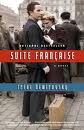
Suite Française by Irène Némirovsky

Suite Française is a posthumously novel published by Irène Némirovsky, a Russian Jew who lived in Paris during the German occupation. It had originally been intended to be a five-part work, modeled after a Beethoven symphony. However, Némirovsky was arrested and deported in 1942 and eventually died at Auschwitz before the work was completed. The work that exists today was found in a suitcase by her daughters Denise and Elizabeth who could not bear to read their mother's words. The novel was eventually published in 2005.

The first part of the novel is "Storm in June" and recounts the massive exodus of Parisians at the time of the German occupation through the eyes and actions people of people trying to flee the city. The Péricands are a wealthy family who have their servants pack all their belongings for them. They will be traveling to Nimes. Gabriel Corté, a writer, is fleeing with his mistress. The Michauds are a couple that work for a Parisian banker. They originally believed that they would be evacuated with the rest of the bank workers, but were left behind when there was no room for them. They were given orders to meet the bankers by a given time. Charles Langelet goes it alone by trying to steal gasoline from unsuspecting motorists. At times comical, poignant and very satiric, this movement of the symphony is allegro.

The second part of the novel is "Dolce" and is told through the eyes of Lucille Angellier whose husband is a prisoner of war. Her disdain for him because of his unfaithfulness leads her down the path of guilt as she must come to grips with her romantic feelings for Bruno, a German soldier who is billeted in the house that she shares with her mother-in-law. Their platonic relationship grows into what will more than likely become a romantic one. Or will it? To complicate matters, a German officer is shot by a local hunter and Lucille is drawn into the situation when asked to harbor the criminal. The novella is the adagio movement, told slowly and serenely. The descriptions are incredibly beautiful with the reader dwelling on each phrase as to breathe in the scene that is being created.

Némirovsky was a devout fan of Tolstoy's War and Peace and also Turgenev and Chekhov. As we think what would have been if she had finished this literary symphony, we can only surmise that it would have been on equal standing with Tolstoy's masterpiece. She was an accomplished writer at the time of her death and we can be thankful that at least we have a portion of her masterly crafted opus magnus.

Sunday, March 7, 2010

Little Heathens: Hard Times and High Spirits on an Iowa Farm During the Great Depression by Mildred Kalish

The March selection for the Flower Library Book Club, Little Heathens...by Mildred Kalish was just a delightful book to read. I was a bit skeptical at first when I ordered the book. Was this going to just be another down and out book about the gloom of living through the Great Depression? I can't imagine what it was like to live during the time that so shaped the spirit of my grandparents, parents, and, really, our country. But what a surprise to read a book with such an upbeat point of view.

Kalish recounts her life in this NY Times top book of 2007 as one of the Little Kids growing up on a farm in Iowa. The book is more than a memoir; it is a prescription on how to live independently and with pity and suffering. The book begins "My childhood came to a virtual halt when I was around five years old. That was when by grandfather banished my father from our lives forever for some transgression that was not to be disclosed to us children...His name was never spoken again in our presence; he just abruptly disappeared from our lives." That beginning would be enough to whet any reader's appetite. But we never read another word about her father. And that is the way life would be for a family brought up with spirit of Independence.

Children were expected to do chores, pitch in with the planting and harvesting and play on their own. If they got a cut or bruise, they didn't immediately run for the attention of their parents, but dealt the best they could. They lived with out electricity, indoor plumbing, cars and mobile phones, and SURVIVED. When you bought something it was meant to last for a while. The phrase, "waste not, want not" really had meaning and it wasn't doom and gloom.

Little Heathens is also a compendium of home remedies and recipes. Kalish was born the same year that my mother was and for this reason I felt as I was reading the book that there was so much that was familiar. I had heard a lot about these remedies, household solutions, and have eaten the meals that were part of the family's repertoire. The beginning of Chapter 11, Farm Food resonates today - after breakfast the first question that was asked is what to have for dinner? My mother did this and I do today. If I haven't made out the week's menu, that is the order of business on my agenda.

I truly enjoyed this book and really wanted more after each chapter. I know I will go back and reread parts of this book. I can actually see it being used as a curriculum related read. It would give great insight into an era that did produce a great generation. It brings us back to the reality of what we need to live - resourcefulness, love, and family.

Sunday, February 14, 2010

Three Cups of Tea by Greg by Greg Mortenson and David Oliver Relin

Three Cups of Tea has been on the New York Times Best Sellers list for 3 years. It has been selected by countless book clubs and "one book" one community reads since its publication. I read this for the February discussion of the Flower Memorial Library Book group. I was excited to finally read it. In my last year at Sackets Harbor School I had planned to do a "one school" one book program with it since it was available as a picture book and middle school book. I was sure I would love the book when I read it, but I didn't. I struggled with the names and places and found that it was taxing trying to follow the authors' travels to and from Pakistan.
Mortensen's story begins when he arrives in a remote village of Pakistan in 1993 after a failed attempt to climb to the summit of K2. He is exhausted, barely conscious, and is nursed back to health by the villagers. He makes a promise to return to the village and build a school for the children, especially the girls. The book is an accounting of how he makes this dream become a reality and the setbacks and triumphs that occur along the way. It amazed me as he set about his campaign to raise money that he was unaware of how to use a computer. The process both in the U.S. and Pakistan was painstakingly slow. Numerous trips to Pakistan resulted in roadblocks from a bridge that needed to be constructed so that supplies could get to the designated area, to the kidnapping and imprisonment of Mortensen. The story of bringing his dream to reality is inspiring and amazing. He continues his work today as well as maintaining a very rigorous speaking schedule.

Once again, I encounter a woman who is an absolute saint for standing in support of her husband's endeavors. Mortensen met and married Dr. Tara Bishop on a return trip home from Pakistan. It was virtually love at first sight and an incredible meeting and marriage. She has supported his many trips and his devotion to the cause of education in Pakistan.

What bothered me about the book was the style in which the book was written. I often felt that I needed a road map to make sure I was in the right place. The authors switch localities back and forth without much transition. The names caused me to struggle as well. I was glad to hear that in his follow-up book Stones into Schools now has a "who's who" as well as a glossary of Pakistani vocabulary. Many schools in the US have adopted his Pennies for Peace campaign. One can read about Mortensen and his projects at the Three Cups of Tea website.

Wednesday, January 20, 2010

Year of Living Biblically by A.J. Jacobs

It has been busy around the house and that has left little time for reading. Definitely hope to remedy this in the days and months to come. After all, isn't that a major part of retirement? Between preparing for Thanksgiving, then a Holiday party for 75, Christmas, and the major upheaval of kitchen floor remodeling, it has been tough to actually sit down for any length of time without feeling guilty.

The Year of Living Biblically was the January selection for the Flower Memorial Library Book Club. This was not a book that I would have chosen on my own. A.J. Jacobs describes himself as "Jewish in the way the Olive Garden is an Italian restaurant." In effect he is an agnostic. As he considers his son's upbringing, a book deal and a need for some spirituality in his life, Jacobs decides to live according to the rules of the Bible for a year. He fastidiously writes down 613 rules from the Old Testament and dedicates himself to following the rules to what he and his advisers consider the literal interpretation. The year-long journey is not an easy one and Jacobs communicates his path with a sense of reverence for the Bible and with humor that keeps the reader entertained throughout.

No matter what one's religious affiliation, one must respect the dedication that A.J. Jacobs to his task. The book is broken down by each month of the year and contains the Biblical references to the part of the scripture on which he is concentrating that month. He does not cut his hair or shave his beard and wears a white shepherd's robe as well as carrying a stick. He must have been a sight riding the subways in New York. There were many obstacles in his way - he could not touch his wife or anything that she touches during her "time of the month." But that extends to any woman so he must buy a special seat to use in public places as well as his home so as not to violate that rule. He is commanded to build a hut (a sukkah) and needs to live in it for a week. But there is no space to do this except in his apartment. His wife must be a saint.

Jacobs is an obsessive compulsive learner. His previous book chronicled how he read an encyclopedia from A-Z. He spends countless hours reading about all the facets of the Jewish faith, but also extends his quest for knowledge to other religious sects. He visits the Amish in Pennsylvania, Jerry Falwell's church in Lynchburg, VA, a snake handler church in TN and his orthodox Jewish Uncle Gil in Israel. In his hometown he attends Bible study groups when he moves into the rules of the New Testament, about 8 months into his spiritual journey.

One might conjecture that living Biblically for a year would create a transformed person. But that wasn't the way it was for Jacobs. The reader does sense some change in him. He describes himself at the end of the book as a "reverent" agnostic. He understands the sanctity of life and how precious it is. He no longer regards prayer as something foreign, but a natural part of his day. During the course of the year he and his wife become parents of twin boys who join his son Jasper. He learns that discipline is an important part of parenting and we know that he will follow through with this "rule." He ends the book with thoughts about "cafeteria" religion, and how picking and choosing from scripture is practiced by all religious groups and it may not be all bad. "The key is to choosing the right dishes. You need to pick the nurturing ones (compassion), the healthy ones (Love they neighbor), and not the bitter ones." Amen.

For an insight into A.J. Jacobs, view his interview on the Today Show.

Wednesday, November 18, 2009

The Guernsey Literary Potato Peel Society by Mary Ann Shaffer and Annie Barrows

This was the November selection for the Flower Library Book Club. I had had it on my "to read" bookshelf for a while and was so glad that I could now move it to the top of the list. I took it to London in October and was able to read it on the train to Cardiff and then on the one to Oxford. It was the perfect background setting for another English read.

The year is 1946 and Juliet Ashton has survived the war in London despite having lost everything when her apartment was bombed. She receives a letter from Dawsey Adams from Guernsey, a Channel Island. He found her name in a book by Charles Lamb and wanted a recommendation of any other books by him. It was then she learned of the GLPPS, founded as a ruse to cover up a pig roast during the German occupation of the island. (Pigs were counted and could not be consumed by the inhabitants of the island.) The epistolary novel takes shape as the residents of Guernsey correspond with Juliet and she with them, her publisher, and best friend.

The character development and point of view is what makes this novel work. We are treated to the thoughts and daily activities of those who formed the literary society except for the founder herself - Elizabeth, who was arrested and taken to France. As the residents of the island join in on the correspondence the reader is treated to the nuances of a new group of friends. There is Dawsey, Isola who posses a stack of her grandmother's letters, Eben Ramsey, reader of Shakespeare, Will Thisbee, creator of the pie, and Remy who travels from France to join the group. Interspersed with these letters are Juliet's letters to Sydney, her publisher, and Sophie, Sydney's sister and Juliet's sounding board. Also present is the spirit of Jane Austen whose books are brought to mind even as one reads GLPPS. As Juliet's affinity toward her Guernsey correspondents develops, so does a romantic encounter with the rich and suave Mark. We peek into this relationship as the letters, often 3 or 4 on the same day, are exchanged between the couple. We know what's best for her and we hope that she will eventually discover that for herself.

A nagging question: Why does Sophie not write back to Juliet?

Can I just say that this is one of the most refreshing and engaging books that I have read recently. One laughs, cries, empathizes, and is inspired by the life that these islands residents have lead. I wanted to read more and not have the book end. I wish I had stumbled on this map before reading the book. Would that I could journey to Guernsey and immerse myself in the history of this island. A grand read!

Tuesday, October 20, 2009

Turtle Moon by Alice Hoffman

It has been a few weeks since I have posted my books. I have been reading, but also traveling and need to catch up with the reviews. I think I am finally home for a while now. Turtle Moon was the October selection for the Flower Memorial Book Club. I enjoy the book club because it does force one to read outside one's comfort zone. I have only read one Alice Hoffman book and that was the YA novel, Green Angel. Turtle Moon embraced many of the same ideas and themes - the struggle to overcome a horrible lot in life and the presence of a supernatural being that helps in that struggle.

Coming to Verity, FL, home to more NY divorcees than any other place on Earth, Lucy
Rosen and her soon Keith have escaped from Long Island, NY. It is the month of May when the heat and humidity are nearly unbearable and when strange occurrences are the norm. One never questions what happens in May when the turtles begin their ritual migration. During this month babies wail and rattlesnakes have been known to roost on top of a phone booth and refuse to come down. It is May that is the reason for the murder of Karen Wright, a neighbor in Lucy's apartment. At the same time Karen's baby and Keith have disappeared. Hoffman then spins a tangled web of pursuit, intrigue, and introspection as she unveils what has happened in the small town. The story goes from Florida to Long Island and back as she solves the two crimes. The characters are well-developed, but it is the lyrical descriptions that really impressed me about the book. Hoffman's use of metaphor, simile, and personification in her prose beg to be read aloud at times.

It would be natural for the reader to dislike Keith for his actions at school and home. However, he, for me, was a very sympathetic character. I liked him for what he was down deep inside and for his really knowing right from wrong when it counted. He, like so many teens today, have had a very difficult road to travel in a short life and one can empathize with him and the other teens we have encountered.

A very satisfying read and an author to read again.

Saturday, September 19, 2009

Ladies of Liberty by Cokie Roberts

Cokie Roberts, author of Founding Mothers, published her second book, Ladies of Liberty, on the influential women of the early days in 2008. The research that went into both of these volumes is well documented and presented. Roberts has a style of writing that makes history comes alive, although, I must admit, that some sections were much more alive than others.

Roberts begins Ladies of Liberty with the election of John Adams to the presidency and continues to the presidency of James Monroe. Throughout this time frame we are introduced to the women behind the men. The stories of these incredible women are retold mainly through their letters to the Founding Fathers and other women of their inner circle. These women were really movers and shakers and influential as they were the eyes and ears of their husbands who were often the only connection the men had to the home front as they were carrying out the business of the new country. Roberts' history is really storytelling at its epitomé. We are treated to scene after scene in the lives of women like Abigail Adams, Louisa Johnson Adams, Dolley Madison, Betsy Monroe, Theodosia Burr, Rosalie Calvert, Martha Jefferson, Martha Washington, and even Sacajawea.

I was especially intrigued by the strength that these women showed. The story of how Sacajawea was so confident in her guidance of Lewis and Clark as they trail blazed the Louisiana Purchase kept me turning pages, eager for her next adventure and discovery. The fortitude of Louisa Adams, wife of John Quincy Adams, is for us And then there was Dolley Madison. She set the expectations for what the home of the President and the first lady should be. Abigail Adams is a woman about whom I can never learn enough. No matter what book I read I always pick up a new tidbit or insight into her life. She was a woman to be reckoned with in her time. Who else would write to a President and ask that he bring her son home from Russia because it was too cold and the salary was not enough to sustain life there?

Roberts pays special homage to women who were social reformers, those who sought to care for orphans and the education of women. As a graduate of Wellesley College she remembers and honors those whose mission was to serve and not to be served. Likewise, we should not forget the likes of Emma Willard and Rebecca Gratz.

As I was reading this book a number of recurring themes stuck in my mind. I kept wondering what it would have been like and how our history might have been different if communication had been better. We would have known that treaties had been signed before battles fought. I am amazed at the mortality rate of children and how mothers and fathers dealt with these tragedies. Along the same vein, the mortality of women in childbirth was as scary. And yet women still endured pregnancy one after another. What if our Founding Mothers had access to birth control? Finally, we should take note and be thankful for all that our ancestors endured and the pride that they had for their families and their country. They serve as an example for us all.